Kirtan
Call-and-response singing of sacred mantras with drums and hand cymbals. No experience or singing ability needed — many people simply listen.
No Sanskrit required. Here is what we practise, where it comes from, and why we think it is worth sharing.
We are not trying to convert anyone. We are trying to be useful.
The Vedic tradition teaches that every living being is looking for the same thing — to love and to be loved without conditions. Everything we do at the center is a small, practical attempt at that: feeding people, singing together, reading carefully, keeping the door open.
If someone leaves a little calmer, a little less hungry, or a little more curious than when they arrived, the evening was worth it.
"Vedic" comes from the Vedas — a body of Sanskrit texts from ancient India, among the oldest writings that humanity still reads and uses.
They are not only religious books. They describe music, architecture, medicine, astronomy, ethics, cooking and family life, all held together by one idea: that material and spiritual life are not two separate departments.
Vedic culture, then, is simply a way of living where ordinary things — a meal, a song, a greeting, a day's work — are done with awareness and offered to something greater than yourself.
You do not have to accept any of it to enjoy it. Most of our visitors come for the atmosphere first and the philosophy much later, if at all.
Most people meet yoga as physical postures. In the classical texts, though, yoga simply means "connection", and there are several routes to it: through the body, through knowledge, through meditation, and through devotion.
Bhakti yoga is the path of devotion — the idea that the heart, not the intellect or the body, is the fastest way to reconnect. It is practised through remarkably simple things: singing sacred names, hearing and discussing scripture, cooking and sharing food, and serving other people.
It asks for no special talent, no flexibility and no early-morning ice baths. It works in a kitchen as well as in a temple.
Call-and-response singing of sacred mantras with drums and hand cymbals. No experience or singing ability needed — many people simply listen.
Quiet, individual repetition of mantra on a strand of 108 japa beads. We can show you how in about ten minutes.
A weekly reading and open discussion of India's best-known philosophical dialogue. Questions and disagreement are welcome.
Janmashtami, Ratha Yatra, Govardhana Puja, Gaura Purnima and more — colour, music, dancing and enormous amounts of food.
Vegetarian cooking done attentively and offered before it is eaten. The result is what we call prasadam.
The main weekly gathering: kirtan, a short talk, and a full meal together. The easiest evening to come to for the first time.
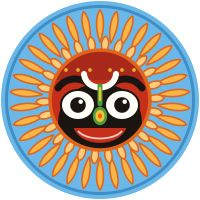
Jagannath means "Lord of the Universe". He is worshipped together with his brother Baladeva and his sister Subhadra, and his form is unmistakable: bold, simple, almost childlike, with huge round eyes that never close.
The tradition says those eyes are wide open because he is looking at everyone — with no filter for background, caste, nationality or worthiness.
Every year during the Ratha Yatra festival he leaves the temple in Puri and is pulled through the streets on a towering wooden chariot, so that anyone at all can see him. That festival is why our colours are saffron, gold and deep red, and it is the spirit we try to keep all year round.
Short, straight answers to the things people ask us most.
Bhakti yoga is the yoga of devotion: one of the classical paths described in the Bhagavad-gita. Instead of physical postures, it is practised through singing sacred mantras (kirtan), mantra meditation on japa beads, studying scripture, and serving others — most visibly by cooking and sharing vegetarian food.
No. Bhakti is practised by people who keep the faith they were raised in and by people with no religion at all. Nobody at the center will ask you to convert, sign anything or give up your existing beliefs.
Kirtan is call-and-response singing of sacred mantras, usually accompanied by a drum and hand cymbals. One person sings a line and everyone answers. There is no audience and no performance — you can sing, clap, dance or simply sit and listen.
Mainly the Bhagavad-gita and the Srimad-Bhagavatam, in translations with the original Sanskrit alongside. Both are available in our shop, and we are always glad to lend a copy to someone who wants to read before buying.
We teach mantra meditation, which is the meditation practice of bhakti yoga, and we are happy to show you how to use japa beads. We do not run asana (physical posture) classes at the center.